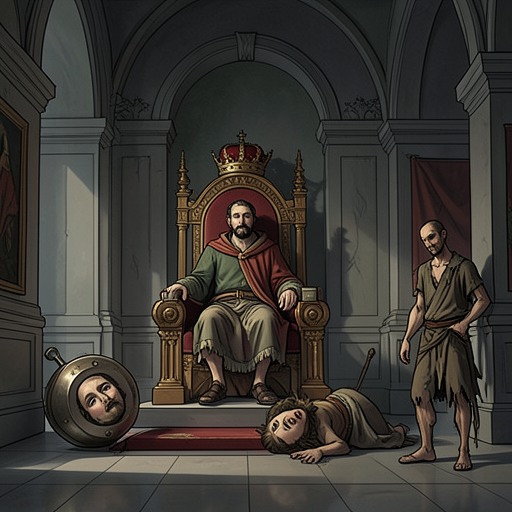
Pompey the Great
The Canterbury TalesPompey the Great is recalled as a noble Roman governor whose military prominence cannot protect him from betrayal and ruin. Though he belongs to a catalogue of celebrated rulers and commanders, his defining scene is not triumph but the abrupt collapse of power: after fleeing a battle, he is beheaded by one of his own men, who hopes to win Julius Caesar’s favor by presenting Caesar with the severed head.
Identity and Historical Position
Pompey the Great is introduced within a sweeping account of rulers, princes, dukes, and earls whose courage and martial labor seem to promise lasting glory. The narrator places him among the great figures summoned to measure the scale of worldly achievement, then singles him out as a noble governor of Rome. His identity therefore combines political authority, military reputation, and Roman greatness, but the catalogue also prepares a counterpoint: however elevated a person may be, worldly status remains exposed to Fortune’s reversals.
The passage links Pompey directly with Julius Caesar, not as a distant name in a list but as a participant in a decisive Roman conflict. Caesar faces Pompey in Thessaly, while Pompey draws the forces of the East around him. The scale of the confrontation emphasizes Pompey’s command and the magnitude of the political world he inhabits, even as the later account reduces that grandeur to a single vulnerable body and a severed head.
Battle, Flight, and Betrayal
Pompey’s immediate crisis begins when Fortune turns against him. The narrator describes Caesar as having advanced successfully until Fortune becomes his adversary, then turns attention to Pompey, who has taken flight from the fray. Pompey’s movement away from battle marks the reversal of his public identity: the celebrated governor and commander is now represented as a defeated fugitive.
His defeat is followed by a more intimate and dishonorable danger. One of Pompey’s own men is characterized as false and traitorous, and this man beheads him after the battle. The murder is not presented as an act of loyalty, justice, or military necessity. It is a calculated betrayal in which Pompey’s death becomes a political offering, converting the fallen leader’s body into an object through which the killer seeks advancement.
Caesar and the Severed Head
The traitor’s objective is to gain the favor of Julius Caesar. He therefore brings Pompey’s severed head to Caesar, believing that the murder will purchase approval from the victorious rival. The episode compresses the logic of political opportunism into a stark exchange: Pompey’s former authority disappears, while the traitor treats his remains as a token of allegiance to the new power.
The scene also preserves an important distinction between the killer’s intention and its moral meaning. The man acts to win favor, but the narrator identifies him through treachery rather than commendation. Pompey’s death thus exposes the instability of a world in which military defeat is followed by betrayal from within one’s own ranks, and in which loyalty can be performed through violence against the defeated.
Fortune and Narrative Significance
Pompey’s appearance belongs to the poem’s larger meditation on the mutability of earthly greatness. He is recalled after the narrator has invoked the extraordinary achievements of powerful rulers, so his downfall interrupts the expectation that glory, courage, or office can secure a stable ending. The movement from Roman command to flight, execution, and posthumous political display makes Fortune’s reversal concrete rather than abstract.
Pompey also functions as a tragic example within the narrator’s historical catalogue. The evidence does not develop his private life or inner thoughts; instead, it gives him a sharply outlined public identity and a concentrated downfall. His story is memorable because the distance between rank and fate is so extreme: the noble governor of Rome ends as the victim of a traitor’s ambition, while his severed head is delivered to the very rival who defeated him. In that contrast, Pompey’s greatness becomes inseparable from the warning that power, once exposed to Fortune, may be overturned with terrifying speed.